
Bhutan the land of happiness
Trip Snapshot
- Tour destinations: Thimphu, Gangtey, Punakha, and Paro
- Tour duration: 6 nights/7 days.
Setting your feet into the country, you will see why Bhutan is named the Last Shangri La. Adventure hikes in this tour itinerary such as hike to Chimi Lhakhang and Tiger’s Nest are added for the exciting experience of hiking to the sacred sites. It takes 2 hours to hike to the main temple of Tiger’s Nest monastery, but the scenery when one reaches the summit is breathtaking and totally worth your effort. It’s a must visit holy site for every visitor to the country.
Besides the National Memorial Chorten, you will also see Gangtey monastery which is the only Nyingmapa monastery in this region. Take your time to get to know the cultural life by discovering the Paro town and Thimphu town and be awed by the friendliness of Bhutanese. You also take Gangtey Nature Trail to discover the scenic Phobjikha valley, all in this tour.
Day-by-Day Itinerary
DAY 01 Paro to Thimphu
Upon landing in Paro (2,300 m – 7,545 ft), you will have a great overview of the snow-capped mountains of the Himalayas. Our representative will then take you to Thimphu – the capital of Bhutan at 2,400 m (7,874 ft). From Paro, it is about 55 km (34 mi) to get to Thimphu, which will take approximately 1.30 hours. But along the way, we can already start to explore Bhutan by first visiting Tachoggang Lhakhang (Temple of The Excellent Horse). This beautiful temple was built by the legendary Bhutanese bridge builder Thangtong Gyalpo (1385-1464).
On the way, we will visit the renowned Gagyel Lhundrup Weaving Centre and discover the vibrant traditions of Bhutanese textile artistry. Here you can observe skilled artisans at work, meticulously hand-weaving exquisite garments, accessories and home decor using traditional looms and vividly colored silk threads. Engage with the friendly weavers to learn about their ancient craft’s cultural significance. Try your hand at weaving during interactive workshops or find beautiful handwoven souvenirs like kiras and scarves to take a piece of Bhutan home.
After we get to Thimphu, the next stop is the National Memorial Chorten. It was erected by Bhutan’s Third King, His Majesty Jigme Dorji Wangchuck for world peace and prosperity, and later became a memorial to the Late King as well. This Tibetan-style building is one of the most iconic religious edifices in Thimphu, and is the focus of daily worship for many Bhutanese.
Later, let’s head to the General Post Office for you to make your own stamp – a unique souvenir for your loved ones at home.
The next visit is to Buddha Point (Buddha Dordenma Statue), a massive statue at a height of 51.5 m (168 ft), one of the largest in the world. The statue is said to fulfil a prophecy from the 8th century A.D. that was discovered by Terton Pema Lingpa (Religious Treasure Discoverer). The giant sculpture, with thousands of smaller Buddha statues inside, emanates an aura of peace, and happiness to the entire world.
If your trip happens on a weekend, we can visit the farmer’s market to see all kinds of fruits, vegetables, meat, and even incense sold here from all over the country. Then you can explore the lively Thimphu town and see the local’s daily life when wandering between shops.
All kind of items can be found on Norzin Lam street, from souvenirs, woven clothes to local wine. Nightclubs are also a great place to enjoy good music and good cocktails in Thimphu.
DAY 02 Discover Thimphu
On the morning, we will hike to Tango monastery. This is a moderate hike with an elevation gain of 400 m (1,312 ft). It will take about 1 hour to get there (2,5 km -1.5 mi), and we will hike through forests of blue pine, oak trees, and rhododendron. When we climb up a hill, we will also pass through alpine woods.
At an altitude of 2,800 m (9,186 ft), Tango monastery is a renowned university of Buddhist studies, and Tango is the highest level which is equivalent with the master degree in academy studies. While the original site of Tango was founded back in the 12th century, the current building was the work of the ‘divine madman’, Lama Drukpa Kunley, built in the 15th century, is also the residence of Gyalse Rinpoche, an important tulku (reincarnated lama), who is recognised as the seventh reincarnation of the fourth desi (secular ruler), Gyalse Tenzin Rabgye (the founder of Tashichho Goemba).
We will visit Changangkha Lhakhang in the afternoon. This temple is quite popular with the locals since parents traditionally go here to choose auspicious names for their newborns or to receive blessings for their young children. It perches on a ridge above central Thimphu, and once you are inside, check out the shrine to the tshomen (mermaid) in the central courtyard and then enjoy the excellent view from the back kora (pilgrim path), with its lovely block-and-gold prayer wheels.
After that, you will learn more about 13 traditional arts of Bhutan when we are at the National Institute for Zorig Chusum, commonly known as the Arts And Crafts School’ or the ‘Painting School’. You will see students practicing different arts like painting thangkas – painted religious pictures, walls, and statues to the decorations on furniture and window-frames), embroidery (hangings, boots, clothes) or clay arts (religious statues, pottery), wood carving (masks, statues).
Today’s last destination is Tashichho Dzong (Fortress of The Glorious Religion). The dzong was first constructed in 1216 A.D by Lama Gyalwa Lhanangpa. It had gone through expansion and reconstruction over the years, and eventually been completely renovated by King Jigme Dorji Wangchuck after he moved the capital to Thimphu. The imposing dzong is located close to Thimphu town, next to the banks of Wang Chhu River. Make sure you will not miss the captivating scene of flag changing at 5pm. The ceremony begins in the courtyard and ends outside in the front of the dzong.
DAY 03 Thimphu to Gangtey
After two enriching days in Thimphu, you’ll set your sights on Gangtey, a journey that covers 160 kilometers and takes about six hours. The drive itself is a highlight, especially with a stop at Dochula Pass at 3,050 meters. Here, you’ll be rewarded with sweeping panoramic views of the eastern Himalayan ranges. On clear winter days, the scene is particularly magical—108 chortens stand in tranquil grace along the mountain pass, framed by a breathtaking backdrop of snow-capped peaks.
While at the pass, you’ll also visit Druk Wangyal Lhakhang, a temple built to honor His Majesty the Fourth Druk Gyalpo, Jigme Singye Wangchuck.
Upon arriving in Gangtey, you’ll visit the Gangtey Goemba, or Gangtey Monastery, perched dramatically on a hilltop overlooking the valley. It is the only Nyingmapa monastery in the region and was founded in 1613 following a prophecy by the renowned 15th-century treasure finder, Pema Lingpa. From this vantage point, you’ll take in the full sweep of the Phobjikha Valley—a glacial haven that serves as the winter home of the rare and elegant Black-Necked Cranes.
DAY 04 Gangtey to Punakha
After two days in Thimphu, you’ll set your sights on Gangtey, a journey that covers 160 kilometers and takes about six hours. The drive itself is a highlight, especially with a stop at Dochula Pass at 3,050 meters. Here, you’ll be rewarded with sweeping panoramic views of the eastern Himalayan ranges. On clear winter days, the scene is particularly magical—108 chortens stand in tranquil grace along the mountain pass, framed by a breathtaking backdrop of snow-capped peaks. While at the pass, you’ll also visit Druk Wangyal Lhakhang, a temple built to honor His Majesty the Fourth Druk Gyalpo, Jigme Singye Wangchuck. Upon arriving in Gangtey, you’ll visit the Gangtey Goemba, or Gangtey Monastery, perched dramatically on a hilltop overlooking the valley. It is the only Nyingmapa monastery in the region and was founded in 1613 following a prophecy by the renowned 15th-century treasure finder, Pema Lingpa. From this vantage point, you’ll take in the full sweep of the Phobjikha Valley—a glacial haven that serves as the winter home of the rare and elegant Black-Necked Cranes. You’ll spend the night at a hotel in Gangtey, surrounded by the serene beauty of this remarkable valley.
A pleasant hike is a great way to start today’s journey — the Gangtey Nature Trail will take us to discover the scenic Phobjikha valley. The walk is very popular as it leads from the small hilltops overlooking Gangtey Goemba down to lovely flower meadows then to Semchubara village. From here, we will continue passing through pristine forest of blue pines before descending to a valley viewpoint and finishing the hike at the picturesque and small Khewang Lhakhang (Khewang temple).
Then we will drive to Punakha. On arrival in the old capital, we will visit Punakha Dzong (Palace of Great Happiness), built in 1637. The edifice was the second dzong to be built in Bhutan, and served as the seat of the Bhutan government until early 1950s. The impressive building was also where the wedding of the King of Bhutan, Jigme Khesar Namgyel Wangchuck to Jetsun Pema was held.
Passing the dzong, we will head to see Pho Chhu suspension bridge – the longest of its kind in Bhutan. The 160m bridge is decorated with colourful prayer flags, and from the bridge you will have the stunning view of Punakha Dzong and the alluring landscape of Pho Chhu valley.
The hike to Khamsum Valley Namgyal Chorten is also a nice walk through scenic rice fields and pine trees. It only takes about 1 hour to reach the striking chorten at an altitude of 1,500m, which stands on a ridge above Punakha valley. The renowned structure is one of the finest exemplar of Bhutan’s architectural and artistic traditions and the only one of its kind in the world. The majestic chorten was erected by Her Majesty the Queen Mother for the wellbeing of the whole country as well as for the long life of our beloved King. Because of its location on the ridge, this is where you can have the best view of Punakha valley.
DAY 05 Punakha to Paro
We will drive back to Paro today. On the way, we can enjoy the lovely walk across hillock fields to Chimi Lhakhang (Temple of Fertility). The temple is popular as childless women go to the temple to pray and receive a wang (blessing or empowerment). The trail to the stunning temple takes about 25 minutes and passes through farm lands of Lobesa Village. You will get the opportunity to see farmers at work on the way up to the site.
In the afternoon, we will visit the impressive Paro Rinpung Dzong (Fortress of The Heap of Jewels), another great example of Bhutanese architecture. The dzong was erected in 1644, on the foundation of a monastery built by Guru Rinpoche. The massive structure with its buttressed walls can actually be seen throughout the valley. Today the place houses both the monastic body and district government offices, including the local courts.
Then we will go to the National Museum of Bhutan (or Ta Dzong). The building has a unique circular construction resembling a conch shell. After the time of war, it became the National museum with extensive collections of Bhutan’s thangkas, festival masks for Tshechu dances as well as textiles, weapons and armour. An underground tunnel is said to lead from the dzong to the water supply below.
The late afternoon is designed for an explorative walk around Paro’s main streets and market, and we will stay overnight at the hotel in Paro.
DAY 06 Paro sightseeing
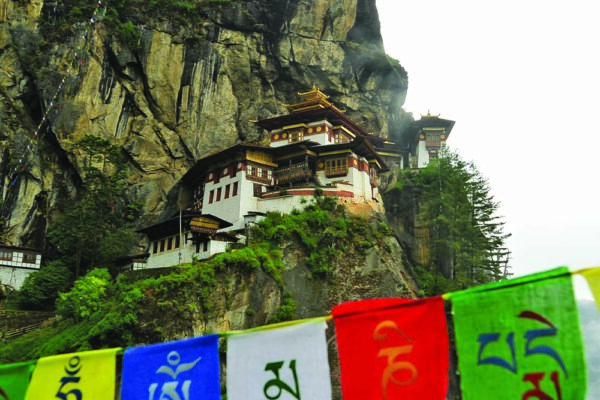
The local saying goes: “If you have never been to Tiger Cave Temple, your trip to Bhutan is not complete.” The sentence alone has already shown how important Taktsang Monastery (or Tiger’s Nest) is to the Bhutanese. The holy place clings to a cliff more than 3,000 m (9,842 ft) above sea level and 900 m (2,952 ft) above the Paro valley floor. The walk to the temple is 4.5 km (2,7 mi) one way, with an elevation gain of around 900 m ( ). Along the trail, we will take multiple stops so you can enjoy and take photos of the incredible landscape of Paro valley, with dense forests and enormous mountains. The untouched nature is why Bhutan becomes a hotspot for hikers and nature-lovers.
After that, we will head to one of Bhutan’s oldest and most prominent temples — the Kyichu Lhakhang. It is one of the 108 temples built in the Himalayas by the Tibetan King Songtsen Gampo in the 7th century, marking the introduction of Buddhism in Bhutan. The scene of elderly pilgrims constantly shuffling around the temple and spinning its many prayer wheels makes this one of the most fascinating spots in Paro valley.
In the late afternoon, we will join a local family for a special dinner in a traditional farm house. You can definitely enjoy your time with the loveliest people, chatting over authentic Bhutanese dishes.
We also recommend trying out archery, which your guide and driver will happily teach you. This is one of the most popular sports in the country, practiced in almost every family.
A nice traditional hot stone bath at the farm house after all the hiking is also a great way to relax your body.
You can otherwise spend time checking out some cool pubs in Paro, where they have amazing snacks and local alcohol for your last night in Bhutan.
You will stay in Paro for the last night of the holiday.
DAY 07 Depart Paro
After breakfast at the hotel, your guide will accompany you to the airport for flight to your onward destination. Tashi Delek (goodbye and good luck) and we hope to see you again!
Tour Requirements
Have Any Question?
Talk to our team — we reply within 24 hours, every day.
-
Phone +975 17 172 094
-
WhatsApp +975 77168484
-
Email btcordinator@gmail.com